






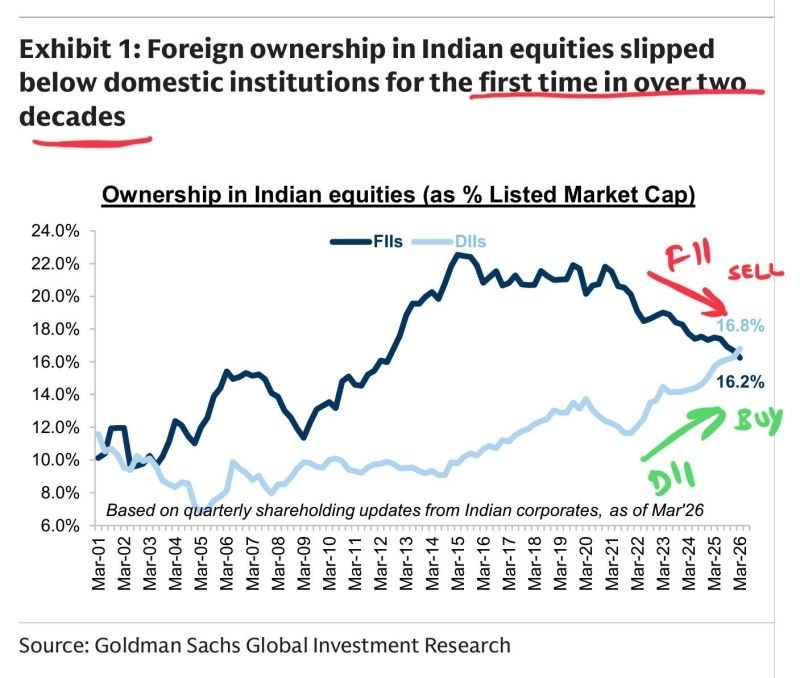
 Domestic investors now hold a larger share of Indian equities than foreign investors for the first time in more than two decades. That is a sign of growing local market strength, but it also reflects sustained foreign selling and weaker global appetite for India relative to AI-led markets.
Key Takeaways
- Historic shift: Domestic institutional ownership has risen to 16.8%, ahead of foreign institutional ownership at 16.2%.
- Domestic resilience: Strong household savings and steady retail participation have absorbed heavy foreign selling.
- Valuation support: India’s valuation premium versus global markets has largely disappeared, making relative valuations more attractive than they have been in years.
- Global headwinds remain: Capital is currently gravitating toward AI-linked markets such as the US, Korea, Taiwan, Japan, and China.
- Index weight has fallen: India’s weight in the global emerging market index has dropped from 21% in 2024 to around 12% now.
- Main risk: India remains sensitive to external oil shocks and to the duration of the current global AI-driven capital cycle.
Detailed Breakdown
For the first time in over two decades, domestic institutional investors now own a larger share of Indian equities than foreign investors. Based on the March 2026 shareholding snapshot, DII ownership stands at 16.8%, while FII ownership has declined to 16.2%.
This is an important market signal.
On the positive side, it shows that Indian markets are no longer as dependent on foreign flows as they once were. Domestic savings remain strong, retail participation continues to deepen, and local institutions have shown they can absorb large bouts of foreign selling without the market structure breaking down.
That is the glass half-full view.
The second positive is valuation. India’s long-standing premium versus many global markets has faded sharply. By recent historical standards, this is a rare event. If one looks at relative valuation history over the past two decades, India has only been this inexpensive versus other markets a handful of times.
But there is also a glass half-empty interpretation.
Foreign selling has not been light or temporary. It has been heavy and persistent. The fall in FII ownership is not only because domestic investors are buying more, but also because foreign investors have been actively reducing exposure.
A big part of that is global positioning. India is not currently seen as a direct AI market beneficiary in the same way as the US, Korea, Taiwan, Japan, or even parts of China. Global capital is chasing the AI theme aggressively, and that has pulled attention and flows away from India.
This shift is also visible in benchmark positioning. India’s weight in the global emerging market index has fallen sharply from a 21% peak in 2024 to 13% in January 2026, and now to roughly 12%.
There is also a macro vulnerability to keep in mind. India remains more exposed to oil shocks than several competing markets. If energy prices rise sharply, that can quickly affect inflation expectations, current account dynamics, and sentiment toward Indian assets.
Conclusion
The key message is not that India has become weak. In fact, the rise of domestic ownership is a structural positive for long-term market stability.
But it would be a mistake to read this as an unambiguously bullish signal.
Domestic money has become strong enough to cushion the market. That is encouraging. At the same time, foreign investors are still voting with their feet, and global capital is still more excited about AI-heavy geographies than about India right now.
In practical terms, this creates a mixed but interesting setup:
- market resilience has improved
- valuation comfort has increased
- foreign sponsorship has weakened
- global narrative support is currently elsewhere
That combination can create selective opportunity, but it also argues for realism rather than euphoria.
This is a landmark change in Indian markets. Domestic investors overtaking foreign investors is a sign of maturity and deepening financialization within India. That structural shift matters.
At the same time, the reason it has happened also matters. It reflects not just domestic strength, but also sustained foreign caution, lower index weight, and a global market environment still dominated by the AI trade.
So the signal is best read as constructive, but not complacent.
Source: Goldman Sachs Global Investment Research